
ICE CUT-OFF
By Webjørn Landmark
As long as there has been fishing and trapping along our coast, it has been men who have been the focus and have been the ones who have carried out this fishing, and later the Arctic sea trapping. There were many shipwrecks, and many men did not return to their loved ones. The history of Norwegian seal hunting is full of dramatic accounts of shipwrecks in the fight against drift ice. Much has been written about this history.

But less is written about her, who always stayed home when her husband and often one or more sons traveled on the Arctic Ocean. As a rule, their sons began this dangerous voyage as soon as they had received their priestly ordination.
The Ishavskjerringa and the fisherwomen were responsible for the homestead with cattle, sheep, the castle and often a large flock of children. Many also had parents and in-laws to take care of, as was common at the time. She also rowed the small boat to look after the household, and took on work salting herring on the sea farms in the villages. In season, you could find the Ishavskjerringa working with drumming and processing sealskins.
Of course, they thought about the danger of sending a husband and son to the Arctic Ocean. Those who were with them didn't tell much about the drama when they got home. It was best not to cause a stir. Usually things went well, but more than once both father and son have come away on the same ship. In small rural communities like Brandal, there was no connection to agriculture. It was the sea and later the Arctic Ocean that was the workplace.
There were strong, independent women who stayed home, with large groups of children, who kept most of the things under control while the men were out on the Arctic Ocean. Those who were out did not have a radio at first to report back home about how things were. She who stayed at home did not know anything from the time they went out around the cape until the ship arrived sailing towards the beautiful beaches of home again. There she stood, out on the outer cape, scouting for the ship when it was waiting for home. She somehow found an errand out there. Often the neighboring women took turns finding such errands out on the cape. Was the flag at full or half mast true? Often they did not come at all. The shipwrecks were many and dramatic. The biggest disasters were in 1917 when seven ships sank, six in the ice and the seventh on its way to Greenland. 87 men were lost. The second was as late as 1952 when five ships with 78 men were lost. 48 wives with 98 minor children were left at home without their breadwinner.
44 of those missing in 1952 were from Troms, 34 were from Sunnmøre. A fundraiser was started for the bereaved. By May 14, the sum had already reached 600.000 kroner. Director Kristoffer Aamot of the Oslo Municipal Cinematographers' Association announced that the municipal film agencies had agreed to donate the box office revenues from their films to Selfangerhjelpa on a specific day. The theatre managers in Oslo followed up by donating 50 orchestra seats from each theatre. The Norwegian National Broadcasting Corporation donated the revenues from two charity concerts to the same cause. On May 15, there was a motorcycle rally at Dælenenga in Oslo. There were 5422 paying guests, and the entire revenue went to Selfangerhjelpa. By August, 2,4 million kroner had been raised for the bereaved to apply for support from. Far from all of these funds collected were distributed.
This was in 1952. But back in 1917 there were no support systems. The ships did not have radios, and the ships that got away were not reported missing until well into the summer. It was not until August that ships were sent out to search. By then it had probably been several months since they disappeared. Nevertheless, two fishing boats and an entire ship's side were found after this accident.
Imagine what she felt on the Icebreaker that went home and waited. All the ships were stubbornly heading for land. Where were their ships? They should have come home long ago. It was the same with many of the other shipwrecks where crews got away, or men were missing and perished in other ways. They showed little. But when the time approached for the ships to be waiting for home, they constantly found themselves going out on the rocks and looking out to sea, scouting for the ships, and were excited to see how high the flag hung.
They had only hoped to hold on.
We have often written "Ships of wood - crews of iron", we can in good conscience add "Ships of wood and women of steel". This story could have been taken from many villages along our coast. Those who sat at home and waited did not receive any medals, but were almost forgotten.
In Brandal, Oleif Eiken wanted to do something about this, and took the initiative to start work to erect a monument to the "women of steel" who were waiting at home. The ice sculpture was unveiled by Oleif himself at the Ishavsmuseet in 2005. Oleif grew up in the Arctic village of Brandal, where everyday life every spring was characterized by the men getting ready to go out on the ice.
The Arctic Circle will remind us all, both today and in the future, of their great efforts and responsibility for their children, grandparents and homesteads. While the men fought their battle against the forces of nature on the Arctic Ocean to make a living and in many cases never returned home.
Here I will discuss a couple of the Icebreakers in Brandal who had to go through more than most.
The two are Gurine Liavåg and Emma Brandal. It was no coincidence that their boys were named "Gurina-gutane" and "Emma-gutane". Both were widowed early, the sea took their husbands, both lost their ships, both were left with children who had to be fed and clothed. Both toiled and struggled for themselves and their families in a way that would be unthinkable today.
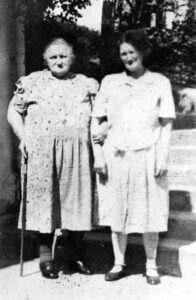
Gurine Mur Liavåg
First, we tell you about Gurine, or Mura-Gurina, as she was commonly called.
Gurine was born on November 25, 1879, and died on July 16, 1963. Her parents were Elisa Petersdtr. Korsnes, sister of Ole P. Brandal (Leit) and Elias Grimstad. (clock-Elias). Her father was Peter Johannesson Saudebø, who bought Muren. There Gurine grew up with two sisters and six brothers. Her father was like everyone else at that time, a bank fisherman and small farmer. He used the sea, and Lisa and the children ran the farm. All six brothers became Arctic seafarers.
Johannes, one of the brothers, describes her roughly as follows: "Gurine was of medium height, had dark curly hair, small, lively eyes, a straight back and a sharp nose. At the age of sixteen or seventeen, no one could match her on the dance floor when the fiddle or accordion was playing."
But fate did not want her life to be a bed of roses, even though it looked very bright at first. At the age of twenty-two, she married Severin Eliasson Liavåg from Gåsneset in Hjørungavåg. He was born on April 1, 1879 and drowned on May 13, 1909.
In 1900 we find Severin Liavåg (in Brandal they always said "Han Gåsnes") in a picture of the crew of "Minna". There he is mentioned as the chief gunner. It was in 1898 that "Minna" was in the ice for the first time. At that time they had gunners from Troms. Severin must therefore have been one of the very first Arctic gunners from Sunnmøre. In 1908 he had the ship "Floren" newly built together with merchant Koppernæs in Ålesund. The ship was 57,1 feet long and was one of the first purpose-built Arctic ships. From 1904 to 1907 he owned, together with several others, the large ship "Avance" which sank off Iceland in 1907.
Well, everything looked bright for Gurine. They built a new house in Brandal on her father's property in 1904. That same year, Einar, the eldest boy, was born. Peter came a couple of years later. The house was large and beautiful for its time. There was even a garden with a fence around it.
But then: In 1908, Severin traveled to Greenland to spend the winter with Peder, Gurine's brother, and two of her siblings. Time passed, a whole year, there was no mail or radio at that time. In the summer of 1909, the "Floren" came sailing in by land with the flag at half-mast. Severin and Gurine's cousin walked through the ice on May 13th when they were going to pick up a polar bear they had shot. It is said that the day "Floren" came home with the flag at half-mast, the playful Gurine became "a woman of steel." Grief froze into steel ice inside her.
Well, life went on. But what were she and the boys supposed to live on? There was no widow's pension, child benefit or any kind of help to be had at that time. Yes, poor people, but people didn't go there, then you were allowed to be so low that you had to crawl, and that was not at all the case for Gurine.
She couldn't stay on the ship "Floren", it was completely unthinkable at that time. Two of her brothers took over Severin's share, Koppernæs the rest. In the summers she took on haymaking work. As soon as the herring came, it came early, often in November/December, it was herring work. Herring salting was paid per barrel, and therefore she had to stand day and night as long as there were herring. When the cod came, it was spotting and salting, and later she had to stand by a boat filled with sea water and wash fish in the north wind and then dry a few thousand in the spring and summer. However, what was the real salvation was the knitting machine. At that time, all fishermen, trappers, yes, basically everyone who had outdoor work, knitted underwear. In the room next to the kitchen, Gurine had her workroom. There she spun, twisted, knitted and sewed underwear. Before each season. When the days were too short, the night was called upon to help.
The boys were not yet grown up before they were preparing boiled fish. It was natural for them to go to sea. As soon as they received the priest's hand, we find them on the Arctic Ocean. In 1930, Einar was with two of her brothers on board the "Kvitis" that sank in the Vesterisen, and was rescued by the "Skansen", where one of Gurine's brothers was the skipper, one was the chief gunner, and he brought his 15-year-old son with him, and then Peter, Gurine's son, was also there. The story of that rescue operation needs to be remembered. In 1939, Einar, together with others, performed a great feat when they rescued the crew of the "Saltdalingen" in a hurricane on their way to Newfoundland. Gurine sat at home, never saying a word. There was no sign of unrest, but what was stirring inside her, only those closest to her know.
Then came the war. Peter ended up in Iceland. He was with the "Polaric". Four of her nephews sailed out. Two were lost at sea. There was peace, Peter came home and became skipper of the "Buskø". Einar became skipper of his own "Veslekari". Now the sorrows were over for the old noblewoman. But, no. Einar got cancer in 1949, and after a short illness he died. His wife was left with seven boys, the oldest 14 years old.
Again the strong-willed old woman stood up: "We'll manage ourselves." Once again we find Gurine, her son's wife and the boys around the boat washing fish. Cold and sour, "but we'll manage ourselves." The sea gives, but the sea takes. One day one of the youngest boys in the spring drowned in the mud. Another victim.
But the bad days were not over for Gurine yet. On Easter weekend 1952, there was a rumor of an accident during a hurricane in the Vesterisen. When the priest prayed for the ships and crew during the service, Gurine sat straight, as if petrified. During the sacrifice, she walked calmly and steadily around the altar. But during communion, when she fixed her eyes on the stained glass, tears fell.
In the last years of her life, she lived at Hareid Rest Home. Every Sunday during sermons, she sat with her eyes fixed on the stained glass window of the Master reaching out to Peter as he sank in the storm.
Then on July 16, 1963, the old, tired, noblewoman fell asleep, she who the sea was so hard on. But she who never let herself be broken.
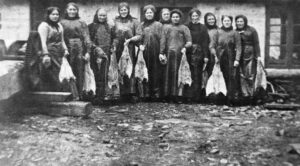
Emma Brandal
Another woman of honor in Brandal was Emma Brandal. Emma was from Godøya, or Gøyna as she herself said. She was born on October 10.10, 1872. Her father's name was Bernt Godø.
In 1899 she married Rasmus Rasmusson Brandal. He was known as Lisje-Rasmus even though he was a big man. His father was also called Rasmus, so that's why he got the nickname.
Everything looked bright for Emma when she came to Brandal. Her husband was a successful skipper who owned a ship together with his brother Lars. In 1906 they built a new ship, 57,7 feet long and named it "Skjold". In 1912 the ship was lengthened and given an engine. The name was now changed to "Isspurven". Merchant Koppernæs in Ålesund now bought Lars' half share.
Emma and Rasmus bought his farmstead Gullik Grimstad and put it up on her brother Lars' property. It still stands there today. Yes, Emma could see the light of day. Not many people had running water and washing machines at that time, but Emma did. She also had a small garden with a fence and a garden gate! Of course, it was hard work for a young wife to stay at home with a flock of young people week after week, month after month while her husband was at sea. But that was the division of labor at that time. She knew nothing about the ship from the time she went to sea until she came sailing back along the shore. And the flock of young people grew. The most "uncle-followed" were Gustav b. 1899, Bernt 1901, Reidar 1903, Alf 1905, Agnes 1907, Severin 1909, Solveig 1910, Edit 1912 and Rasmus 1914. But what did hard work and toil do when you had a house, food and a plentiful income?
One didn't demand more that time. One was happy.
But the merciless fate reached Emma, just as he had beaten the neighbor's wife, Gurine, a few years before.
On New Year's Day 1914, the "Isspurven" went down north of Kristiansund. The entire crew was lost. Four men from Brandal followed the ship into the sea. They were: Skipper Rasmus Brandal, his son Hermann Brandal, his nephew Sivert Brandal and the neighbor's boy Harald Landmark. The rest of the crew were from other villages. It may be mentioned that another ship from Brandal went down the same night. It was "Rapp", owned by Rasmus Brandal from Pe-garden. Two of his sons, Iver and John, were lost, as was his nephew from Risegarden.
Yes, so Emma sat there again with the group of children. Gustav was 15 years old, and Rasmus wasn't born for six months. Now the good days were over. The ship was gone, the husband dead. If it were today, a disaster team would have been in place with a priest, psychologist, psychiatrist, child welfare educator and all sorts of committees and social security.
There was no such thing back then. It is said that when fate struck Gurina, she became a woman of steel. Emma did not. She was soft and could cry, but soft can be as tough as steel is hard. Both of the two neighbor women had an unyielding will to survive on their own.
And then we find the two of them working side by side on herring, fishing, fish drying and haymaking. The children went out early to help, the girls inside and the boys at sea. Soon the boys had received their priest's hand for them on the Arctic Ocean, and then things got easier financially, but then came what was worse. The home was hit by tuberculosis, which was then ravaging our villages. Agnes, the eldest daughter, was married to skipper Rolf Kvien. They had a son, but then Agnes died of tuberculosis.
Then Edit died in 1934, Solveig in 1936 and Rasmus in 1946. During the war, Bernt sailed abroad, and what he went through there could have been written books about. Alf and Rasmus sailed on the coast. We can only imagine what the hard-working mother was put through. Bernt came home, took up the Arctic Ocean fishing business, but had probably suffered a health breakdown and died young.
Then one day Emma was able to rest. She fell asleep on February 7, 1954, at the age of 80.
We can happily recall that from about 1850 to 1980, around 50 men from Brandal found their graves at sea.
The idea of a memorial to the women who stayed at home did not arise during their lifetime. Many of the women were forgotten, but fortunately, more memorials have been erected in recent times to honor them.
In the period from 1991 to 2018, the following 11 statues were erected:
1991 The Herring Wife Tore Bjørn Skjølsvik Ålesund
1992 The Clipfish Woman Tore Bjørn Skjølsvik Kristiansund
1997 Fisherman's Wife with Children Tore Bjørn Skjølsvik Fosnavåg
1997 The Fishmonger Ola Stavseng Veiholmen, Smøla
1997 The Sailor's Wife Harald Wårvik, Rørvik, Vikna
1999 Fisherman's Wife Per Ung, Pier at Svolvær
2000 The Sailor's Wife Tore Bjørn Skjølsvik, Kilsund, Arendal
2004 The Sailor's Wife Nina Nesje, Tjøme
2005 The Iceberg Slayer Tore Bjørn Skjølsvik Brandal
2007 The Fisherman's Wife Tore Bjørn Skjølsvik Vartdal
2018 The Fisherman's Wife Tore Bjørn Skjølsvik Kveøya, Kvæfjord
Local historian Magnulf Bjørndal had an appeal on May 17th at the wreath of memorial stones at Hareid cemetery in the 1970s, a list of many women in Brandal who lost theirs, under the heading "Those who did not receive a medal". We include Bjørndal's appeal in its entirety here:
"Those who didn't get a medal"
One day I stood in Hareid churchyard and read "Minnesteinane". Then I came to think that behind all these names there was at least one name, a mother or a wife.
Not a single one of these women has had their name on a memorial stone or history book, and it is unlikely that they will.
Suddenly I saw all the women of Brandal who had lost husbands, sons or close relatives. So I went home and wrote down what I could think of. There are probably more I have forgotten, but at least these names are now mentioned.
I now go from farm to farm, and from house to house in Brandal. I only mention mothers and wives.
We start at the first house when we come from Hareid to Brandal.
Jenny Klepp. Or Klepp-Jenny in everyday speech, is the first hard worker. She had 13 children. This was before child benefits, washing machines, vacuum cleaners and home freezers and the era of refrigerators. Her husband was a machinist on the Brandalsskutene, so the income was usable for his time, but she was an unusual hard worker.
As early as 1909, Jenny lost a cousin and the husband of another cousin. They walked through the ice in Greenland while hunting polar bears with the "Floren Expedition."
In the disastrous year of 1917, both of her brothers were lost in the Vesterisen. They were captains of their own ships. Then the war came in 1940. The husband was an engineer on the "Veslekari", and entered Allied service. So she did not know where he was. The eldest son, Olav, was an engineer and sailed out, sometimes across the Atlantic, and other times in the Mediterranean. One day he was gone. Son no. 2, Oddmar, was an engineer on the cargo liner "Cygnus". During an air raid he was hit by a shrapnel shell. Then he was dead. In 1945 the husband came home, but his heart had been broken, he died shortly afterwards. Two more sons died. This woman never received emergency help. She managed on her own.
Berte-Oline Skarbakk lived in the next yard.
One day in 1887, she and the boy, Olav Brobak, were waiting for the new ship "Perlen" to come and pick up the boy who had come into Bruaplassen to pick up his clothes bag. The ship did not come. It went straight out onto the banks, and never came back. Berte-Oline was left with a little boy. The man who was the skipper, her father-in-law, and a brother-in-law came along with the new ship. Eline Hovlid Skarbakk, in everyday speech "Spytar-Elina, was Berte-Oline's sister-in-law. She was left with a little boy who was named after his father, Elias.
Serina Brandal, who lived down the road on Skarbakken, lost her brother-in-law in the same sinking.
Oluffa Brandal in the neighboring yard was Berte-Oline's sister and thus lost her brother-in-law.
Johanne Brandal (Bakke-Johanne) had a visit from her nephew, Elias Midtflø one day in 1924. He brought his son Hans with him. They sailed home out of Buhammaren. Elias drowned. Hans was rescued. Johanne's father-in-law had also come across the sea.
Olaug Brandal lived on the other side of the Storelva River. Two of her uncles went to sea. Seven in 1914 with the "Issporven" and Ragnvald in 1916 when the "Onward Hoo" sank in Alaska. Also two brothers-in-law and a nephew.
Olaug Brandal Sivertsen lived on the other side of the road. Her father and uncle were lost in the Vesterisen in 1917. She was named after her father, who was named Ole. He was a skipper on the "Lunheim". Two of her cousins were killed in the war.
Hansi Brandal lived 20 meters from Olaug. Her brother-in-law came to Vesterisen in 1952.
In Runnane sat Runne-Laura . Her sister-in-law lost her husband and son.
Andrea Brandal (Liset-Andrea) lived at the crossroads of Indredalsvegen. Her husband, Karsten Brandal, was lost in the Vesterisen in 1952, he was a gunner on "Buskø". His son, Lars Peter, managed to be shipwrecked twice before he was 16 years old, but survived. One of Andrea's maternal uncles was lost out on Egga, and her cousin Johannes perished in the Arctic Ocean in 1930.
Anna Brandal (Rise-Anna) lost her brother in 1914 when the "Rap" sank, and at the same time two siblings. Anna and Sverre later lost two Arctic ships, but fortunately no one was killed, they were rescued.
Petrine Brandal (Rise-Petrina) was without her son, Olaf, when the "Rap" sank in 1914. He was there with two siblings. Petrine was the sister of Berte-Oline Skarbak who lost her husband when the "Perlen" sank in 1887.
Oline Brandal (Plasse-Olina) lost a brother and three siblings in 1905 when the "Heimdal" (the Bjåstad boat) sank on its way home from Iceland. Her brother-in-law Hans was lost on the "Titran night" in 1899. He was a skipper on an Ålesund boat.
Johanne Brandal (Gjerde-Johanne) was badly affected. It was her father who led and owned "Gjerde-Elias-Åttringen" which went missing in 1881. 34 children were left fatherless at that time. Many were left on the farms for fostering. Td Skomakar-Iver in Isakgarden and Andreas Røyset in Håbakkane. Johanne's eldest brother, Johan, went missing when "Perlen" went down in 1887. Her brother Knut drowned in Ålesund in 1893. Johanne's eldest son, Elias, died while herring fishing at Flåvær in 1933.
Judit Brandal (Volle-Judit) in Legebakkane lost her brother Karsten in 1952. He was a gunner on the "Buskø" and her maternal uncle, Karl, in 1917. He was skipper on the "Admiralen". Her maternal sister's husband, Odin Løset, passed away at the same time.
Jakobine Brandal (Lege-Jakobina) had eight sons, and five of them were fishermen and trappers, but strangely enough, none of them made it to sea. She did not escape, two brothers and three nephews took to the sea.
Nikoline Brandal (Leite-Nikolina) had two sons. Both boys, Godtfred and Ole, were skippers and were shipwrecked in the storm in the Vesterisen in 1917. Godtfred's wife was left with two children, and Emilie, who was engaged to Ole, was left with a little girl.
Anna Brandal (Leite-Anna) was left with two small children after her husband Godtfred stepped down as skipper of the "Arctic".
Emilie Rekdal , who was to marry her other brother Ole, who was the skipper of "Lunheim", was left with a little girl after the sinking.
Anna Brandal (Volle-Anna) also had many sons, five in total. All were fishermen and trappers. The husband was a fishing skipper. The son, Karsten, died in 1952. Anna's brother, Karl, died in 1917. The same year, the husband of her sister Anna, Olivia, also drowned. The husband's name was Odin Løset.
Kristine Olsen Bratli lost her father in 1917. He was the skipper of the "Hercules II." Four of her maternal uncles and one brother-in-law went to sea.
Marta Brandal (Pe-Marta) had three sons. The two eldest, Iver and Jon, together with their cousin Olaf, were on their ship "Rap" that went down on New Year's weekend in 1914. The youngest son, Ruben, was too young at the time, but went aboard the new ship "Riis", which was built after "Rap". "Riis" sank in Lake Kvitesjøen, but Ruben was saved.
Lisa Brandal (Mura-Lisa) lived in the next yard. She had six sons. All were fishermen and trappers, but none of them drowned, although several of them were involved in several shipwrecks. In 1909, Lisa lost a son-in-law, Severin Liavaag, and a nephew. They went through the ice in Greenland. After Lisa died, several grandsons drowned. Three of her nephews got lost in the ice while she was alive.
Karolina Brandal (Mura-Karolina) lived in the same house as Lisa. Karolina had a son, Edvin. He was a mate and sailed during the war. He was torpedoed and lost.
Ragnhild Brandal (Mura-Ragnhild) lived across the road. She had two sons, both sailors. The eldest, Peter, was killed by a bomb in London before Christmas 1940. Hans, the other son, first sank with the fishing vessel "Arktos", then on the "Stavangerfjord" where he was a sailor. He later came aboard the "Bergensfjord" and was part of the landing in Sicily. He came home, sank with the "Polarbjørn" off Newfoundland, was rescued by the "Herøyfjord" which sank on the way home, but everyone was saved. He himself has taken part in several rescue operations.
Anna Eriksen Brandal . Her husband was also shipwrecked, but was rescued. Her brother, Kristoffer, was lost during a foreign voyage in the Atlantic Ocean.
Kristine Mur Fjelle lost her brother Peter during the war, as well as her cousins Edvin Mur and Peter Liavåg.
Gurine Mur Liavåg (Mura-Gurina) was hit hard. Her husband drowned while hunting polar bears in Greenland with her cousin in 1909. Another blow came in 1952 when her son, Peter, escaped with "Buskø" in the Vesterisen. A grandson drowned as a small boy away from his homeland.
Emma Brandal lived next door to Gurine. On New Year's Eve 1914, the "Isspurven" sank north of Kristiansund. Her husband was the skipper. Her son Hermann was also on board. So was his nephew Rasmus. She was left with seven children, the oldest being 15 years old.
Margrete Landmark Vartdal lived ten meters from Emma. Her husband was a merchant, but Margrete had three brothers Landmark who went to sea, Harald in 1914 with the "Isspurven", Henrik in 1917, and Vebjørn in 1959, and the fourth Bertel who died in the Faroe Islands during the war.
Karolina Brandal (Rasmus-Karolina) also had two sons, Syver on the "Isspurven" in 1914 and Ragnvald on the fishing boat "Onward Hoo" in Alaska in 1916. Her brother-in-law and his son also came away with the "Isspurven".
Margit Brandal had two brothers-in-law who died at sea.
Kristine Landmark had six sons. The sea took four of them, plus a son-in-law.
Karen Marø Runne Brandal . Her husband Johan sailed abroad during the war. He died in Iceland. Youngest son, Jens, went down with "Borgund". Eldest son sailed abroad too, but came home alive. But he had suffered a heart attack and died young.
Kristine Brandal (Steinhaug-Kista) had eight sons. All of them, and her husband Johan, were trappers and fishermen, but none died at sea. One of her brothers-in-law and a grandson drowned.
Berit Brandal (Sigvald-Berit) escaped and some of her own drowned, but two brothers-in-law were lost.
Petra Eriksen Brandal. The sea took one of her sons, Kristoffer, who was lost in the Atlantic.
Edit Høgtun Brandal lost her son Magnar out at Stadt. He was a skipper and was shipwrecked there.
Alette Brandal lost her husband Magnar in a shipwreck near Stadt.
Kirsten Skeide Brandal lost her husband in a drowning accident in the Baltic Sea while sailing on the "Polarstar".
Karen Holm Brandal lost her husband Knut while wintering in Greenland.
Sisters Anna Lillebø, Laura Lillebø and Kalla Marø lost four cousins at sea. They all had three husbands and sons who were trappers.
Andrea Mossa Olsen Brandal lost her father on the "Hercules II" in 1917, and four maternal brothers went to sea.
Petra Brandal (Rise-Petra) lost her brother at sea in 1914.
Anna Liset lost her brother Laurits and nephew Johannes at sea.
Anne-Marie Liset Røren lost her brother Laurits and nephew Johannes in 1930.
Eiken-Anna had three siblings who died in 1905 on "Heimdal".
I wonder if these very women, mothers and wives, were the last to wander through the thoughts of sons and husbands before the sea took them.
I have now gone through Brandal house by house. There are a few homes that have been cleared, but since they were friends and neighbors, there was not a family that was not affected by the tragedies. The list is an enumeration that is certainly not complete.
**
Sources:
The Arctic Museum's archive
Ishavsmuseet.no/skutekatalog
Henrik Landmark, several notes
Magnulf Bjorndal
Village book for Hareid


Leave a reply